Development of an antifungal liquid soap for gynecological use from extract of the leaves of Astronium urundeuva (aroeira-do-sertão)
DOI:
https://doi.org/10.70151/z271v394Keywords:
candidiasis, polyphenols, pharmaceutical preparations, pharmaceutical technologyAbstract
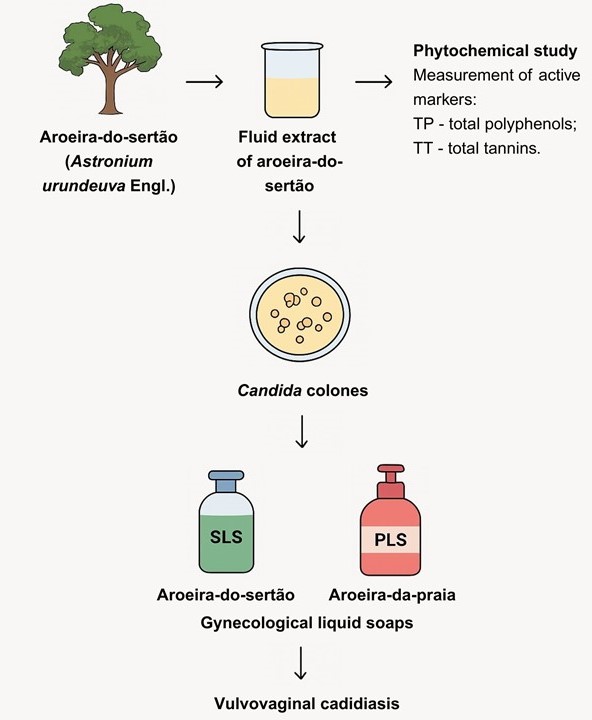
Aroeira-do-sertão [Astronium urundeuva (M.Allemão) Engl.] is a plant with medicinal properties useful in the management of vulvovaginal candidiasis (VVC). Thus, the objective was to develop gynecological liquid soap with antifungal action from fluid extract of aroeira-do-sertão (EFA). The leaves of the adult tree were collected and processed, and the plant drug was characterized. To obtain the EFA, maceration was used followed by percolation with a hydroalcoholic solution (60%), with phytochemical identification and measurement of active markers, polyphenols (TP) and total tannins (TT). The antifungal action of EFA against Candida strains was also evaluated using the agar diffusion technique and the minimum lethal concentration (MLC) was determined. The liquid soap from aroeira-do-sertão (SLS) was evaluated for its quality and antifungal action, being compared to the results of a commercial intimate soap containing aroeira-da-praia extract (Schinus terebinthifolia Raddi – PLS). An EFA of adequate quality was obtained, with a TP content equal to 189.08 (±0.0306) mg EAG/g of EFA, of which only 9.43% corresponds to TT. EFA proved to be effective against C. albicans ATCC 10231, C. krusei ATCC 6258, C. parapsilosis ATCC 22019, and C. tropicalis ATCC 13803, with MLC of 0.5% (w/v). SLS with 2.5% w/v EFA showed appropriate quality and antifungal effect similar to that found for EFA, while PLS exhibited lower antifungal activity due to its composition.Therefore, the formulated intimate liquid soap demonstrated relevant antifungal activity, confirming its potential as an alternative for the management of vulvovaginal candidiasis.
Downloads
References
Anvisa (2017) Resolução da Diretoria Colegiada n° 166 de 24 de julho de 2017. Brasília. 21p. Available at: https://bvsms.saude.gov.br/bvs/saudelegis/anvisa/2017/rdc0166_24_07_2017.pdf. Accessed on: 2 Jun 2024.
Anvisa (2024a) Farmacopeia Brasileira. 7.ed. Volume 1. Brasília: ANVISA. 1112p. Available at: https://www.gov.br/anvisa/pt-br/assuntos/farmacopeia/farmacopeia-brasileira. Accessed on: 7 Aug 2025.
Anvisa (2024b) Farmacopeia Brasileira. 7.ed. Volume 2. Brasília: ANVISA. 880p. Available at: https://www.gov.br/anvisa/pt-br/assuntos/farmacopeia/farmacopeia-brasileira. Accessed on: 7 Aug 2025.
Bandeira MAM (1993) Contribution to the chemical knowledge of plants from the Northeast, Myracrodruon urundeuva Fr. All. (= Astronium urundeuva Engl.) aroeira-do-sertão. 204p. Dissertation (Master’s - Chemistry), Department of Chemistry, Universidade Federal do Ceará, Fortaleza, Brazil.
Bandeira MAM (2002) Myracrodruon urundeuva Allemão (aroeira-do-sertão): Active chemical constituents of the developing and adult plant. 322p. Thesis (Doctorate - Organic Chemistry), Department of Chemistry, Universidade Federal do Ceará, Fortaleza, Brazil.
Bannach AB, Rangel KC, Abreu CS, Malés FC, Morais DC, De Oliveira GP, Zung SP (2022) Assessment of efficacy of a soothing intimate moisturizer in the shaved region by biophysical methods and its effects in the vaginal microbiota. Braz J Health Rev 5:8122-8135. https://scholar.archive.org/work/chiizi5fcncr5gyswgxhofixhe/access/wayback/https://brazilianjournals.com/index.php/BJHR/article/download/47384/pdf.
Bastos JCDSA, Gava APM, de Assis VM, de Oliveira MS, Rodrigues-das-Dôres RG (2020) Qualitative analysis and antimicrobial evaluation of argan oil (Argania spinosa L.) sold in Barbacena-MG. J Biol Pharm Agric Manag 16:94-108. https://revista.uepb.edu.br/BIOFARM/article/view/2197
BrCAST (2021) Brazilian Committee on Antimicrobial Susceptibility Testing. Antimicrobial sensitivity test: Disk-diffusion method. 19p. Available at: https://brcast.org.br/documentos/documentos/. Accessed on: 02 Feb 2024.
Chandrasekar V, Knabel SJ, Anantheswaran RC (2015) Modeling development of inhibition zones in an agar diffusion bioassay. Food Sci Nutr 3:394-403. https://doi.org/10.1002/fsn3.232
Coutinho JAP, Oliveira AP, Silva RS, Martins FT, Lima JM (2021) Surfactants influence on biofilm formation and antifungal activity. Colloids Surf B Biointerfaces 201:111651. https://doi.org/10.1016/j.colsurfb.2021.111651
Cruz JS, Ramos LM, Filadelpho LA, Brito GC, Sousa MM, Cruz GS, Silva EF (2022) Recurrent vulvovaginal candidiasis, herbal therapeutic update: A literature review. Rev Eletrônica Acervo Saúde 15:11220-11227. https://doi.org/10.25248/reas.e11220.2022
Dall LH, Archela E (2013) Determination of phenolic compounds in wine: a review. Exacta 34:193-210. https://doi.org/10.5433/1679-0375.2013v34n2p193
Domingos FR, Silva MAP (2020) Use, knowledge and conservation of Myracrodruon urundeuva: a systematic review. Res Soc Dev 9:11-23. https://doi.org/10.33448/rsd-v9i11.8851
Dong D, Shi YN, Mou ZM, Chen SY, Zhao DK (2022) Grafting: A potential method to reveal the differential accumulation mechanism of secondary metabolites. Hortic Res 9:50-59. https://doi.org/10.1093/hr/uhac050
Freitas RC, Azevedo RRS, Souza LIO, Rocha TJM, dos Santos AF (2014) Evaluation of the antimicrobial and antioxidant activity of Plectranthus species amboinicus (Lour) and Mentha x villosa (Huds). J Basic Appl Pharm Sci 35:1-6. http://200.145.71.41/index.php/ojs/article/view/163
Galvão WRA (2013) Development of pharmaceutical techniques to obtain the plant drug from the shoots and regrowth of Myracrodruon urundeuva Allemão (aroeira-do-sertão). 104p. Dissertation (Master’s - Pharmaceutical Sciences), Department of Pharmacy, Universidade Federal do Ceará, Fortaleza, Brazil.
Galvão WRA (2018) Evaluation of the pharmacochemical potential of Myracrodruon urundeuva Allemão (aroeira-do-sertão) sprouts as a pharmaceutical ingredient. 173p. Thesis (Doctorate - Pharmaceutical Sciences), Department of Pharmacy, Universidade Federal do Ceará, Fortaleza, Brazil.
Gong J, Xiao M, Wang H, Kudinha T, Wang Y, Zhao F, Zhang J (2018) Genetic differentiation, diversity, and drugs susceptibility of Candida krusei. Front Microbiol 9:2717. https://doi.org/10.3389/fmicb.2018.02717.
Hsu H, Sheth CC, Veses V (2021) Herbal extracts with antifungal activity against Candida albicans: A systematic review. Mini Rev Med Chem 21:90-117. https://doi.org/10.2174/1389557520666200628032116.
Kalia N, Singh J, Kaur M (2020) Microbiota in vaginal health and pathogenesis of recurrent vulvovaginal infections: a critical review. Ann Clin Microbiol Antimicrob 19:1-19. https://doi.org/10.1186/s12941-020-0347-4.
Matos FJA (2009) Introduction to Experimental Phytochemistry. 3.ed. Fortaleza: Edições UFC. 149p.
Oliveira FAD, Rorato VC, Almeida-Apolonio AA, Rodrigues AB, Barros ALD, Sangalli A, Oliveira KMD (2017) In vitro antifungal activity of Myracrodruon urundeuva Allemão against human vaginal Candida species. An Acad Bras Cienc 89:2423-2432. https://doi.org/10.1590/0001-3765201720170254.
Pereira MDSV, Ribeiro AD, Júnior ECF, Freire JCP, Costa MMA, Pereira JV (2022) Study on methods used to determine the antimicrobial activity of medicinal plant extracts: clarifications and limitations of the techniques. Braz J Dev 8:26085-26104. https://doi.org/10.34117/bjdv8n4-222.
Sousa TB, Mota GDS, Araujo EDS, Carréra JC, Silva EP, Souza SG, Mori FA (2022) Chemical and structural characterization of Myracrodruon urundeuva barks aiming at their potential use and elaboration of a sustainable anagement plan. Biomass Convers Biorefin 1:1-11. https://doi.org/10.1007/s13399-020-01093-2.
Sustr V, Foessleitner P, Kiss H, Farr A (2020) Vulvovaginal candidosis: Current concepts, challenges and perspectives. J Fungi 6:267-283. https://doi.org/10.3390/jof6040267.
Tanga M, Lewu FB, Oyedeji OA, Oyedeji OO (2018) Cultivation of medicinal plants in South Africa: a solution to quality assurance and consistent availability of medicinal plant materials for commercialization. Acad J Med Plants 6:168-177. https://doi.org/10.15413/ajmp.2018.0133.
Willems HM, Ahmed SS, Liu J, Xu Z, Peters BM (2020) Vulvovaginal candidiasis: current understanding and burning questions. J Fungi 6:27. https://doi.org/10.3390/jof6010027.
Downloads
Published
Issue
Section
License
Copyright (c) 2025 Revista Brasileira de Plantas Medicinais

This work is licensed under a Creative Commons Attribution-NonCommercial-NoDerivatives 4.0 International License.