Phytochemical profile, traditional uses, and biological activities of Duguetia furfuracea: A review
DOI:
https://doi.org/10.70151/2jmg8q56Keywords:
Duguetia furfuracea, phytochemistry, alkaloids, polyphenols, biological propertiesAbstract
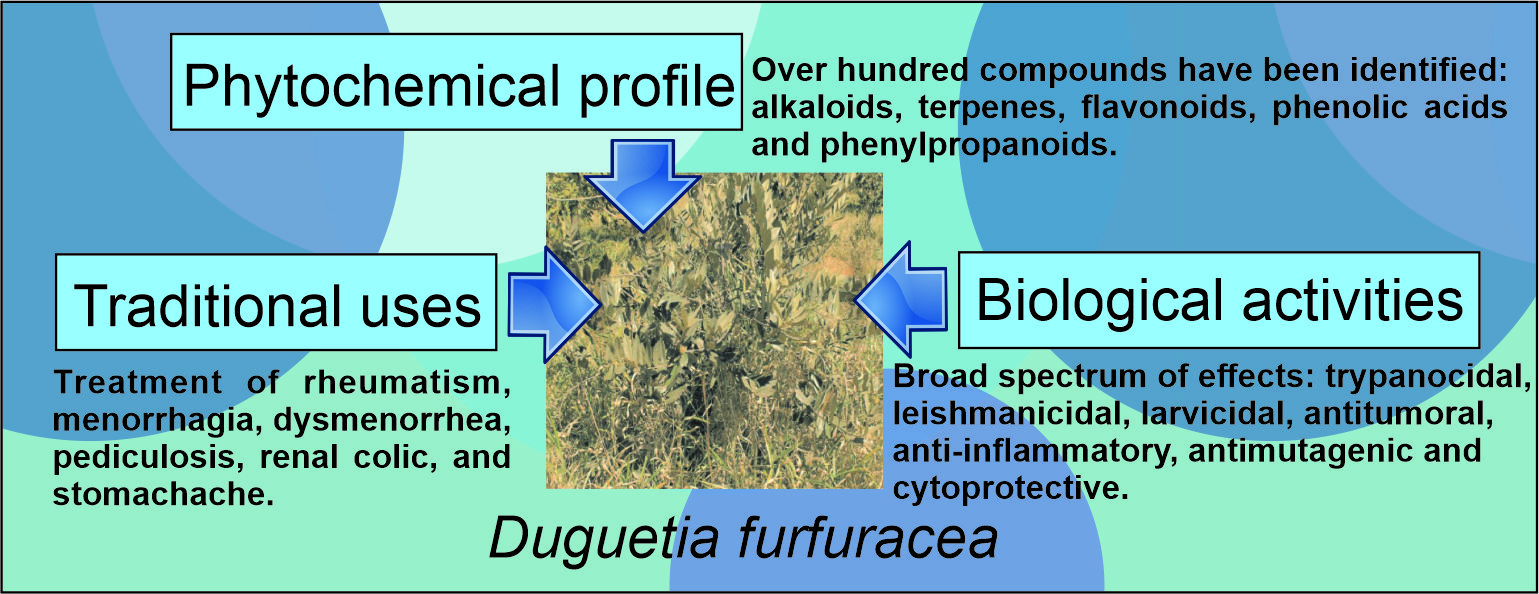
Duguetia furfuracea (A.St.–Hil.) Saff. has ancient descriptions in traditional medicine in the middle-western region of Brazil for multiple therapeutic uses and it is currently considered an invasive plant. The aim of this manuscript is to provide a review of published studies on botany, traditional uses, phytochemistry, biological effects and toxicology of D. furfuracea. Information was collected from databases Scielo, PubMed, Chemical Abstracts and Web of Science. There are several traditional uses of D. furfuracea, in treatment of rheumatism, menorrhagia, dysmenorrhea, pediculosis, renal colic, and stomachache. Based on a phytochemical investigation, over hundred compounds have been identified from the leaves, twigs, underground stem bark and wood of D. furfuracea, such as alkaloids, terpenes, flavonoids, phenolic acids and phenylpropanoids. This species present a broad spectrum of effects such as trypanocidal, leishmanicidal, larvicidal, antitumoral, anti-inflammatory, antimutagenic and cytoprotective. Data about the toxicity are limited, mainly for in vivo experiments. Phytochemical and pharmacological studies have demonstrated the therapeutic potential of D. furfuracea. However, the study of pharmacological mechanisms of its herbal medicinal product and isolated constituents should be further explored, since capsules containing material of this species have already been developed for renal colic.
Downloads
References
Barroso GM, Morim MP, Peixoto AL, Ichaso CLF (1999) Frutos e sementes: morfologia aplicada à sistemática de dicotiledôneas. Viçosa:Editora UFV. 443p.
Behling EB, Sendão MC, Francescato HDC, Antunes LMG, Bianchi MLP (2004) Flavonoid quercetin: general aspects and biological actions. Alim Nutr 15:285-292.
Bontempo M (1994) Medicina natural. São Paulo:Editora Nova Cultural. 584p.
Cao H, Chen X, Jassbi AR, Xiao J (2015) Microbial biotransformation of bioactive flavonoids. Biotechnol Adv 33:214–223. https://doi.org/10.1016/j.biotechadv.2014.10.012
Carollo CA, Hellmann AR, Siqueira JM (2005) Sesquiterpenoids from the essential oil from leaves of Duguetia furfuracea (Annonaceae). Biochem Syst Ecol 33:647–649. https://doi.org/10.1016/j.bse.2004.09.004
Carollo CA, Siqueira JM, Garcez WS, Diniz R, Fernandes NG (2006a) N-Nitrosoanonaine and N-nitrosoxylopine, aporphine Alkaloids from Duguetia furfuracea. J Nat Prod 69:1222–1224. https://doi.org/10.1021/np0600191
Carollo CA, Hellmann-Carollo AR, Siqueira JM, Albuquerque S (2006b) Alkaloids and a flavonoid from aerial parts (leaves and twigs ) of Duguetia furfuracea – Annonaceae. J Chil Chem Soc 51:837–842. https://doi.org/10.4067/S0717-97072006000200001
Carollo CA, Siqueira JM (2008) Isolation of a minor nitro-alkaloid from the aerial parts of Duguetia furfuracea – Annonaceae. Nat Prod Res 23:633-637. https://doi.org/10.1080/14786410802187866
Coelho LS, Felicio LP, Miranda CT, Silva EM, Vale CR, Lima DCS, Duarte SR, Ferreira HD, Chen LC, Carvalho S (2011) Modulatory effects of Duguetia furfuracea (A. St. Hil) Benth. and Hook. f. in Drosophila melanogaster somatic and germinative cells, 2011. Genet Mol Res 10:75–85. https://doi.org/10.4238/vol10-1gmr983
da Silva Coelho L (2003) Medicinal plant based renal colic treatment agent consists of 250 milligramme capsules based on Duguetia furfuracea material. Dervewent Innovations Index Br20022030-A.
do Santos RC, Souza AV, Andrade-Silva M, Cruz KCV, Kassuya CAL, Cardoso CAL, Vieira MC, Formagio ASN (2018) Antioxidant, anti-rheumatic and anti-inflammatory investigation of extract and dicentrinone from Duguetia furfuracea (A. St.-Hil.) Benth. & Hook. f. J Ethnopharmacol 211:9–16. https://doi/org/10.1016/j.jep.2017.09.019
Dutra LM, Costa EV, Moraes VRS, Nogueira PCL, Vendramin ME, Barison A, Prata APN (2012) Chemical constituents from the leaves of Annona pickelii (Annonaceae). Biochem Syst Ecol 41:115–118. https://doi.org/10.1016/j.bse.2011.12.011
Favareto R, Teixeira MB, Soares FAL, Belisário CM, Cabral JF, Silva EA, Moia TA, Cardozo-Filho L (2019) Extraction of bioactive compounds of leaves of Duguetia furfuracea (Annonaceae) using green and organic solvents. Braz J Chem Eng 36:549-556. https://doi.org/10.1590/0104-6632.20190361s20170451
Filho AAS, Andrade e Silva ML, Carvalho JCT, Bastos JK (2004) Evaluation of analgesic and anti-inflammatory activities of Nectandra megapotamica (Lauraceae) in mice and rats. J Pharm Pharmacol 56:1179–1184. https://doi.org/10.1211/0022357044058
Flora do Brasil. (2020) Duguetia furfuracea (A.St.-Hil.) Saff. http://floradobrasil.jbrj.gov.br/reflora/listaBrasil/PrincipalUC/PrincipalUC.do;jsessionid=42612421999ECFD3AAF0DEC454D26655#CondicaoTaxonCP (Accessed 22 April 2023).
Flora e Funga in Flora e Funga do Brasil (2024) Jardim Botânico do Rio de Janeiro. https://floradobrasil.jbrj.gov.br/FB128461. Accessed 05 August 2024.
Jung JH, Pummangura S, Chaichantipyuth C, Patarapanich C, McLaughlin J (1990) Bioactive constituents of Melodorum fruticosum. Phytochemistry 29:1667-1670. https://doi.org/10.1016/0031-9422(90)80142-4
Kahn K, Tipton PA (2000) Kinetics and mechanism of allantoin racemization. Bioorg Chem 27:62–72. https://doi.org/10.1006/bioo.2000.1162
Kim BW, Koppula S, Kumar H, Park JY, Kim IW, More SV, Kim IS, Han SD, Kim SK, Yoon SH, Choi DK (2015) α-Asarone attenuates microglia-mediated neuroinflammation by inhibiting NF kappa B activation and mitigates MPTPinduced behavioral deficits in a mouse model of Parkinson’s disease. Neuropharmacol 97:46–57. https://doi.org/10.1016/j. neuropharm. 2015.04.037
Lago JHG, Junior PA, Moreno PRH, Limberger RP, Apel MA, Henriques AT (2003) Analysis, comparison and variation on the chemical composition from the leaf volatile oil of Xylopia aromatica (Annonaceae). Biochem Syst Ecol 31:669–672. https://doi.org/10.1016/S0305-1978(02)00267-3
Lane AL, Kubanek J (2006) Structure – activity relationship of chemical defenses from the freshwater plant Micranthemum umbrosum. Phytochemistry 67:1224–1231. https://doi.org/10.1016/j.phytochem.2006.05.007
Leboeuf M, Cave A, Bhaumik PK, Mukherjee B, Mukherjee R (1980) The phytochemistry of the Annonaceae. Phytochemistry 21:2783-2813. https://doi.org/10.1016/0031-9422(80)85046-1
Lee JH, Park JH, Kim YS, Han Y (2008) International Immunopharmacology Chlorogenic acid, a polyphenolic compound, treats mice with septic arthritis caused by Candida albicans. Int Immunopharmacol 8:1681–1685. https://doi.org/10.1016/j.intimp.2008.08.002
Lima CNF, Valero TF, Leite NF, Alencar LBB, Matias EFF, Kerntopf MR, Coutinho HDM (2014) Ação protetora de Duguetia furfuracea (A.St.-Hil.) Saff. contra a toxicidade do cloreto de mercúrio em Escherichia coli. Rev Cub Plantas Med 19:179–188.
Lorenzi H (2000) Plantas Daninhas do Brasil: Terrestre, Aquática, Parasitas e Tóxicas. 3rd Nova Odessa:Editora Instituto Plantarum. 608p.
Lorenzi H, Matos FJA (2002) Plantas medicinais no Brasil: nativas e exóticas. Nova Odessa:Editora Instituto Plantarum. 542p.
Maas PJM, Kamer HMV, Junikka L, Mello-Silva R, Rainer H (2001) Annonnaceae from Central-eastern Brazil. Rodriguésia 52:65-98. https://doi.org/10.1590/2175-78602001528005
Macedo AL, Boaretto AG, Silva AN, Maia DS, Siqueira JM, Silva DB, Carollo CA (2021) Evaluation of the effect of Brazilian savanna (cerrado) seasons in flavonoids and alkaloids accumulation: The case of Duguetia furfuracea. J Braz Chem Soc 32:1840-1850. https://doi.org/10.21577/0103-5053.20210075
Maia DS, Lopes CF, Saldanha AA, Silva NL, Sartori ALB, Carollo CA, Sobral MG, Alves SN, Silva DB, Siqueira JM (2020) Larvicidal effect from different Annonaceae species on Culex quinquefasciatus. Environ Sci Pollut Res Int 27:36983–36993. https://doi.org/10.1007/s11356-020-08997-6
Marques GEC, Paz AS, Brandão CM, Nojosa ECN, Ferreira NJL, Muniz RA, Santos DR, Vasconcelos OLS, Reis JT (2023) Soap and moisturizer formulation obtained from the alcoholic extract based on leaves of Duguetia furfuracea (A.St.-Hil.) Saf. Dervewent Innovations Index Br102023008837-6 A2.
Martens LA (2008) Flores da Serra da Calçada. Belo Horizonte: Editora UFMG. 478p.
Mesquita ML, Desrivot J, Bories C, Fournet A, Paula JE, Grellier P, Espindola LS (2005) Antileishmanial and trypanocidal activity of Brazilian Cerrado plants. Mem Inst Oswaldo Cruz 100:783–787. https://doi.org/10.1590/S0074-02762005000700019
Muhammad I, Dunbar DC, Takamatsu S, Walker LA, Clark AM (2001) Antimalarial, cytotoxic, and antifungal alkaloids from Duguetia hadrantha. J Nat Prod 64:559–562. https://doi.org/10.1021/np000436s
Ngo KS, Brown GD (1999) Santalane and isocampherenane sesquiterpenoids from Illicium tsangii. Phytochemistry 50:1213-1218.
Ohwada T, Miura M, Tanaka H, Sakamoto S, Yamaguchi K, Ikeda H, Inagak S (2001) Structural features of aliphatic N-nitrosamines of 7-azabicyclo [2.2.1] heptanes that facilitate N-NO bond cleavage. J Am Chem Soc 12310164–10172. https://doi.org/10.1021/ja010917d
Orhan DD, Özc-elik B, Özgen S, Ergun F (2010) Antibacterial, antifungal, and antiviral activities of some flavonoids. Microbiol Res 165:496-504. https://doi.org/10.1016/j.micres.2009.09.002
Paula-Freire LIG, Andersen ML, Gama VS, Molska GR, Carlini ELA (2014) The oral administration of trans-caryophyllene attenuates acute and chronic pain in mice. Phytomedicine 21:356–362. https://doi.org/10.1016/j.phymed. 2013.08.006
Pedrazzoli Jr, de Carvalho PS, Gambero A (2004) Novas drogas derivadas do diclofenaco contendo heterociclos doadores de NO: composição e método de tratamento de inflamação. Cmax Otimização de Resultados SC Ltda. PI 0405520-9 A2.
Pérez EG, Cassels BK (2010) Alkaloids from the genus Duguetia. Alkaloids Chem Biol 68:83-156. https://doi.org/10.1016/s1099-4831(10)06803-3
Pinho FVSA, Cruz LC, Rodrigues NR, Waczu EP, Souza CES, Coutinho HDM, Costa JGM, Athayde ML, Boligon AA, Franco JL, Posser T, Menezes IRA (2016) Phytochemical composition, antifungal and antioxidant activity of Duguetia furfuracea A.St.–Hill. Oxid Med Cell Longev 2016:7821051. https://doi.org/10.1155/2016/7821051
Pinho FVSA, Silva GF, Macedo GE, Muller KR, Martins IK, Ternes APL, Costa JGM, Athayde ML, Boligon AA, Kamdem .P, Franco JL, Menezes IRA, Posser T (2014) Phytochemical constituents and toxicity of Duguetia furfuracea hydroalcoholic extract in Drosophila melanogaster. Evid Based Complement Alternat Med 2014:838101. https://doi.org/10.1155/2014/838101
Pio Corrêa M, (1978) Dicionário das Plantas Úteis do Brasil e das Exóticas Cultivadas. Rio de Janeiro: Editora Imprensa nacional. 6v.
Pio Corrêa M (1984) Dicionário de Plantas Úteis do Brasil e das Exóticas Cultivadas. Rio de Janeiro: Editora Imprensa nacional. 687p.
Pott A, Pott VJ (1994) Plantas do Pantanal. Corumbá:EMBRAPA. 320p.
POWO (2024) Plants of the World Online. Facilitated by the Royal Botanic Gardens, Kew. https://powo.science.kew.org/. Accessed 05 August 2024.
Priestap HA, Baren CMV, Lira PDL, Coussio JD, Bandoni AL (2003) Volatile constituents of Aristolochia argentina. Phytochemistry 63:221–225. https://doi.org/10.1016/S0031-9422(02)00751-3
Proença CEB, Oliveira RS, Silva AP (2000) Flores e frutos do cerrado – guia de campo ilustrado-baseado na flórula da reserva particular do patrimônio natural “Linda Serra dos Topázios”, Cristalina:Editora UnB.
Queiroz EF, Roblot F, Cavé A, Paulo DQ, Fournet A (1996) Pessoine and spinosine, two catecholic berbines from Annona spinescens. J Nat Prod 59:438–440. https://doi.org/10.1021/np960223w
Rodrigues AMS, Paula JE, Degallier N, Molez JF, Espíndola LS (2006) Larvicidal activity of some Cerrado plant extracts against Aedes aegypti. J Am Mosq Control Assoc 22:314-317. https://doi.org/10.2987/8756-971X(2006)22
Rodrigues VEG, Carvalho DA (2001a) Levantamento etnobotânico de plantas medicinais no domínio do cerrado na região do Alto Rio Grande - Minas Gerais. Ciênc Agrotec 25:102-123.
Rodrigues VEG, Carvalho DA (2001b) Plantas medicinais no domínio dos cerrados. Lavras:Editora UFLA. 180p.
Saldanha AA, Vieira L, Ribeiro RIMA, Thomé RG, Santos HB, Silva DB, Carollo CA, Oliveira FM, Lopes DO, Siqueira JM, Soares AC (2019a) Chemical composition and evaluation of the anti-inflammatory and antinociceptive activities of Duguetia furfuracea essential oil : Effect on edema, leukocyte recruitment, tumor necrosis factor alpha production, iNOS expression, and adenosinergic and opioidergic systems. J Ethnopharmacol 231:325–336. https://doi.org/10.1016/j.jep.2018.11.017
Saldanha AA, Vieira L, Oliveira FM, Lopes DO, Ribeiro RIMA, Thomé RG, Santos HB, Silva DB, Carollo CA, Siqueira JM, Soares AC (2019b) Anti-inflammatory and central and peripheral antinociceptive activities of α-asarone through the inhibition of TNF-α production, leukocyte recruitment and iNOS expression, and participation of the adenosinergic and opioidergic systems. Inflammopharmacol 28:1039-1052. https://doi.org/10.1007/s10787-019-00679-1
Saldanha AA, Vieira L, Maia DSS, Oliveira FM, Ribeiro RIMA, Thomé RG, Santos HB, Lopes DO, Carollo AA, Silva DB, Soares AC, Siqueira JM (2020) Anti‑inflammatory and antinociceptive activities of a phenylpropanoid‑enriched fraction of Duguetia furfuracea. Inflammopharmacol 29:409-422. https://doi.org/10.1007/s10787-020-00775-7
Santos DYAC, Salatino MLF (2000) Foliar flavonoids of Annonaceae from Brazil: taxonomic significance. Phytochemistry 55:567-573. https://doi.org/10.1016/s0031-9422(00)00227-2
Santos TCB, Oliveira RC, Vasconcelos LG, Sousa Jr PT, Silva VCP, Carvalho MG, Ribeiro TAN (2019) Chemical constituents from roots of Duguetia furfuracea (A.St.-Hil.) Saff. (Annonaceae). Biochem Syst Ecol 87:103951. https://doi.org/10.1016/j.bse.2019.103951
Shin JW, Cheong YJ, Koo YM, Kim S, Noh CK, Son YH, Kang C, Sohn NW (2014) α-Asarone ameliorates memory deficit in lipopolysaccharide-treated mice via suppression of proinflammatory cytokines and microglial activation. Biomol Ther 22:17–26. https://doi.org/10.4062/biomolther.2013.102
Silberbauer-Gottsberger I (1981/1982) O cerrado como potencial de plantas medicinais e tóxicas. Oréades 8:15-30.
Silva CR, Vieira PM, Chen-Chen L (2013) Antigenotoxic and anticytotoxic activity of Duguetia furfuracea in bacteria and mice. Genet Mol Res 12:3718–3725. https://doi.org/10.4238/2013.September.19.2
Silva CR, Vieira PM, Santos SC, Chen-chen LEE (2012) Assessment of Duguetia furfuracea genotoxic and cytotoxic activity in bacteria and mice. Anais Acad Brasil Ci 84:149–156. https://doi.org/10.1590/S0001-37652012000100015
Silva DB, Tulli ECO, Garcez WS, Nascimento EA, Siqueira JM (2007) Chemical constituents of the underground stem bark of Duguetia furfuracea (Annonaceae). J Braz Chem Soc 18:1560–1565. https://doi.org/10.1590/S0103-50532007000800017
Silva DB, Tulli ECO, Milit GCG, Costa-Lotufo LV, Pessoa C, Moraes MO, Albuquerque S, Siqueira JM (2009) The antitumoral, trypanocidal and antileishmanial activities of extract and alkaloids isolated from Duguetia furfuracea. Phytomedicine 16:1059–1063. https://doi.org/10.1016/j.phymed.2009.03.019
Siqueira JM, Ziminiani MG, Resende UM, Boaventura MAD (2001) Estudo fitoquímico das cascas do caule de Duguetia glabriuscula - Annonaceae, biomonitorado pelo ensaio de toxicidade frente a Artemia salina leach. Quím Nova 24:185-187. https://doi.org/10.1590/S0100-40422001000200006
Tempone AG, Borborema SET, Andrade Jr HF, Amorim Gualda NC, Carvalho CS, Bachiega D, Lupo FN, Bonotto SV, Fischer DCH (2005) Antiprotozoal activity of Brazilian plant extracts from isoquinoline alkaloid-producing families. Phytomedicine 12:382–390. https://doi.org/10.1016/j.phymed.2003.10.007
Toledo MRS, Peres MTLP, Bazzano TSC, Teixeira IR, Morales LA, Ramos MBM, Valério D, Kitaguti EH, Oliveira HGN, Paula Souza F, Lima ZV (2006) Fitotoxicidade do extrato aquoso de Duguetia furfuraceae (St. Hill) B et H. em ratas (Rattus norvegicus). Rev Bras Plantas Med 8:218-222.
Turrens JF, Newton CL, Zhong L, Hernandez FR, Whitfield J, Docampo R (1999) Mercaptopyridine-N-oxide, an NADH-fumarate reductase inhibitor, blocks Trypanosoma cruzi growth in culture and in infected myoblasts. FEMS Microbiol Lett 175:217–221. https://doi.org/10.1111/j.1574-6968.1999.tb13623.x
Valente PP, Amorim JM, Castilho RO, Leite RC, Ribeiro MFB (2014) In vitro acaricidal efficacy of plant extracts from Brazilian flora and isolated substances against Rhipicephalus microplus (Acari: Ixodidae). Parasitol Res 113:417–423. https://doi.org/10.1007/s00436-013-3670-2
Valter JL, Alencar KMC, Sartori ALB, Nascimento EA, Chang R, Morais SAL, Laura VA, Yoshida NC, Carollo CA, Silva DB, Grassi RF, Fabri JR, Siqueira JM (2008) Variação química no óleo essencial das folhas de seis indivíduos de Duguetia furfuracea (Annonaceae). Rev Bras Farmacogn 18:373–378. https://doi.org/10.1590/S0102-695X2008000300011
Vendramin ME, Costa E, dos Santos EP, Belém Pinheiro ML, Barison A, Campos FR (2013) Chemical constituents from the leaves of Annona rugulosa (Annonaceae). Bioch Syst Ecol 49:152–155. https://doi.org/10.1016/j.bse.2013.03.005
Wang ZW, Ma WW, McLaughlin JL, Gupta M P (1988) 2,4,5-trimethoxystyrene, a bioactive component of the bark of Duguetia panamensis. J Nat Prod 51:382-384. https://doi.org/10.1021/np50056a041
Wozniak D, Oszmianski J, Matkowski A (2006) Antimutagenic and antioxidant activity of the extract from Belamcanda chinensis (L.) DC. Acta Pol Pharm 63:213–218.
Wu C, Li Y, Chen Y, Lao X, Sheng L, Dai R, Meng W, Deng Y (2011) Hypoglycemic effect of Belamcanda chinensis leaf extract in normal and STZ-induced diabetic rats and its potential active faction. Phytomedicine 18:292–297. https://doi.org/10.1016/j.phymed.2010.07.005
Downloads
Published
Issue
Section
License
Copyright (c) 2025 Revista Brasileira de Plantas Medicinais

This work is licensed under a Creative Commons Attribution-NonCommercial-NoDerivatives 4.0 International License.