Anti-adiposity effect of cipó-cravo (Tynanthus fasciculatus), a vine from the Brazilian Atlantic Forest
DOI:
https://doi.org/10.70151/vkvqrt21Keywords:
herbal medicines, phytotherapy, adipose tissue, weight lossAbstract
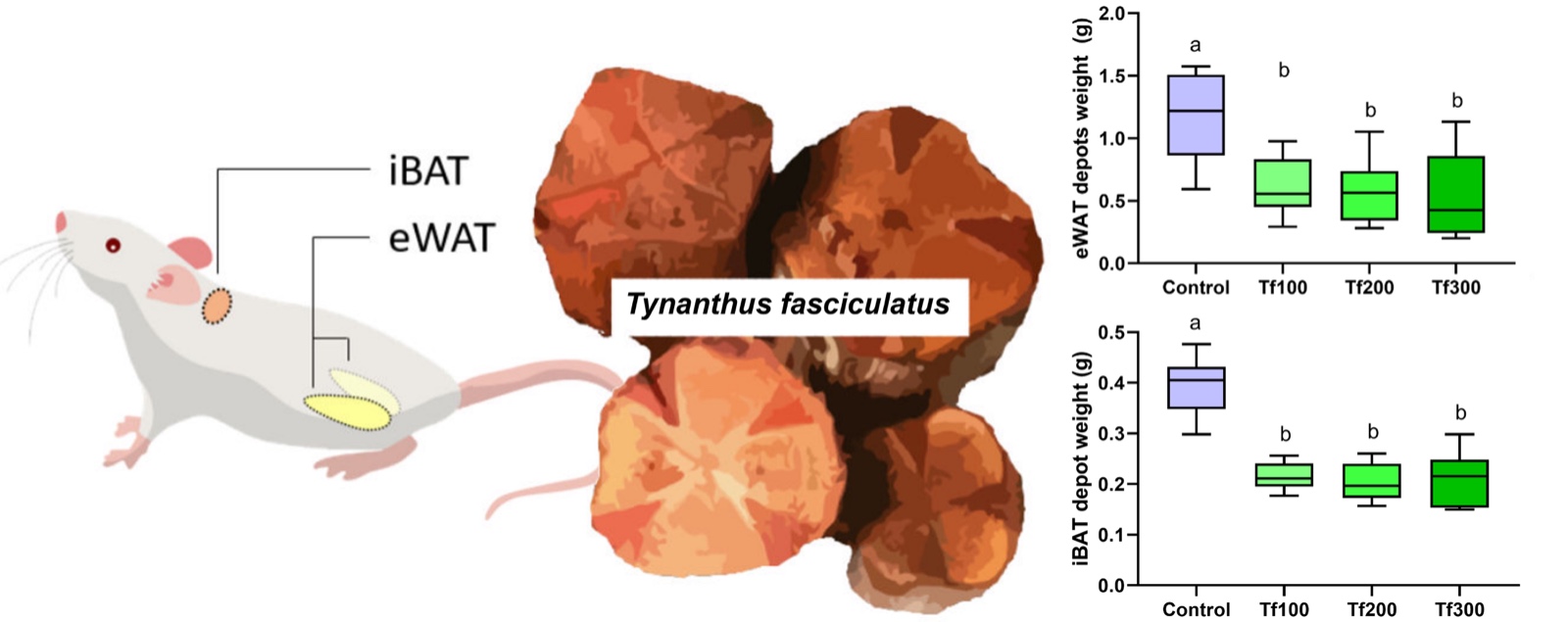
Tynanthus fasciculatus (Vell.) Miers (Bignoniaceae) is a plant used in traditional medicine in southeastern Brazil, with aphrodisiac, antiparasitic, and tonic effects. Its extracts have a range of categories of active compounds identified, but their effects are scarcely reported in the scientific literature. We described, for the first time, the effects of T. fasciculatus infusion on body weight and adipose tissue depot weight in a Swiss mouse model. All studied doses (100, 200, and 300 mg/kg) caused a significant reduction in the weight of the interscapular brown adipose tissue and the epididymal white adipose tissue depots. The doses of 100 and 200 mg were also effective in controlling body weight gain. The infusion of T. fasciculatus was efficient in reducing adiposity and controlling weight gain.
Downloads
References
Bolson M, Hefler SR, Dall׳Oglio Chaves EI, Gasparotto Junior A, Cardozo Junior, EL (2015) Ethno-medicinal study of plants used for treatment of human ailments, with residents of the surrounding region of forest fragments of Paraná, Brazil. J Ethnopharmacol 161:1–10. https://doi.org/10.1016/j.jep.2014.11.045
Brandão MDGL, Cosenza GP, Pereira FL, Vasconcelos AS, Fagg, CW (2013) Changes in the trade in native medicinal plants in Brazilian public markets. Environ Monit Assess 185(8):7013–7023. https://doi.org/10.1007/s10661-013-3081-y
Cansian FC, Merino FJZ, Dias JDFG, Zanin SMW, Miguel OG, Miguel MD (2015) Chemical review and studies related to species from the genus Tynanthus (Bignoniaceae). Braz J Pharm Sci 51(3):515–523. https://doi.org/10.1590/S1984-82502015000300003
Carvalho C, Matta S, Melo F, Andrade D, Carvalho L, Nascimento P, Silva M, Rosa M (2009) Cipó-Cravo (Tynnanthus fasciculatus Miers – Bignoniaceae): Estudo fitoquímico e toxicológico envolvendo Artemia salina. Rev Eletr Farm 6(1):51-57. https://doi.org/10.5216/ref.v6i1.5861
Feng S, Gan L, Yang CS, Liu AB, Lu W, Shao P, Dai Z, Sun P, Luo Z (2018) Effects of stigmasterol and β-sitosterol on nonalcoholic fatty liver disease in a mouse model: A lipidomic analysis. J Agr Food Chem 66(13):3417–3425. https://doi.org/10.1021/acs.jafc.7b06146
Ko JH, Nam D, Um JY, Jung SH, Ahn KS (2018) Bergamottin inhibits adipogenesis in 3T3-L1 cells and weight regulation in diet-induced obese mice. Am J Chinese Med 46(03):601–615. https://doi.org/10.1142/S0192415X18500313
Medeiros MCMPD, Lohmann LG (2015) Phylogeny and biogeography of Tynanthus Miers (Bignonieae, Bignoniaceae). Mol Phylogenet Evol 85:32–40. https://doi.org/10.1016/j.ympev.2015.01.010
Melo FCSA, Matta SLP, Paula TAR, Gomes MLM, Oliveira LC (2010) The effects of Tynnanthus fasciculatus (Bignoniaceae) infusion on testicular parenchyma of adult Wistar rats. Biol Res 43(4):445–450. https://doi.org/10.4067/S0716-97602010000400009
Panda S, Jafri M, Kar A, Meheta BK (2009) Thyroid inhibitory, antiperoxidative and hypoglycemic effects of stigmasterol isolated from Butea monosperma. Fitoterapia 80(2):123–126. https://doi.org/10.1016/j.fitote.2008.12.002
Sae-tan S, Rogers CJ, Lambert JD (2015) Decaffeinated green tea and voluntary exercise induce gene changes related to beige adipocyte formation in high fat-fed obese mice. J Funct Food 14:210–214. https://doi.org/10.1016/j.jff.2015.01.036
Sarker SD, Nahar L (2020) Dietary coumarins. In: J. Xiao, S. D. Sarker, & Y. Asakawa (Eds.), Handbook of Dietary Phytochemicals. Springer Singapore. 1–56. https://doi.org/10.1007/978-981-13-1745-3_37-1
Shabalina IG, Petrovic N, de Jong JMA, Kalinovich AV, Cannon B, Nedergaard J (2013) UCP1 in brite/beige adipose tissue mitochondria is functionally thermogenic. Cell Rep 5(5):1196–1203. https://doi.org/10.1016/j.celrep.2013.10.044
Subandi Zakiyaturrodliyah L, Brotosudarmo, THP (2019) Saponin from purple eggplant (Solanum melongena L.) and their activity as pancreatic lipase inhibitor. IOP Conference Series: Mater Sci Eng 509:012139. https://doi.org/10.1088/1757-899X/509/1/012139
Wang J, Huang M, Yang J, Ma X, Zheng S, Deng S, Huang Y, Yang X, Zhao P (2017) Anti-diabetic activity of stigmasterol from soybean oil by targeting the GLUT4 glucose transporter. Food Nutr Res 61(1):1364117. https://doi.org/10.1080/16546628.2017.1364117
Xu XT, Deng XY, Chen J, Liang QM, Zhang K, Li DL, Wu PP, Zheng X, Zhou RP, Jiang ZY, Ma AJ, Chen WH, Wang SH (2020) Synthesis and biological evaluation of coumarin derivatives as α-glucosidase inhibitors. Eur J Med Chem 189:112013. https://doi.org/10.1016/j.ejmech.2019.112013
Downloads
Published
Issue
Section
License
Copyright (c) 2025 Revista Brasileira de Plantas Medicinais

This work is licensed under a Creative Commons Attribution-NonCommercial-NoDerivatives 4.0 International License.