Traditional knowledge of medicinal plants used to treat livestock in shared pasture communities in some areas of the semiarid region of Bahia, northeastern Brazil
DOI:
https://doi.org/10.70151/a8qf9b63Keywords:
Medicinal plants, ethnoveterinary, ethnobotany, Caatinga biome, plants of BahiaAbstract
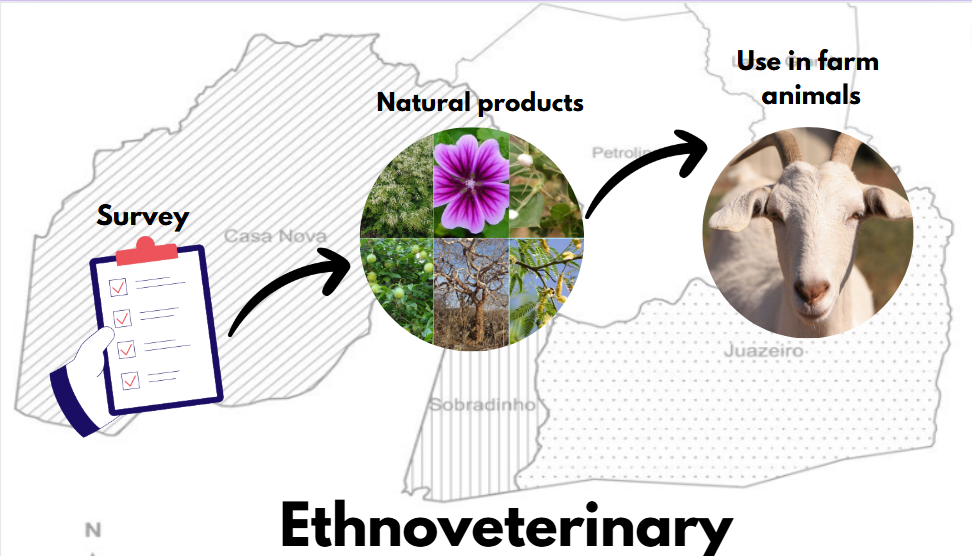
The present study aimed to identify the primary plant species used for treating livestock in the Lower-Mid São Francisco River region of Northeast Brazil. Conducted in rural areas of the state of Bahia, this study focused on traditional shared-pasture farming communities. Interviews with 42 livestock farmers were conducted to evaluate the medicinal use of plants in treating livestock diseases. The use value, citation frequency, relative citation frequency, frequency index, cultural importance index, and relative importance of plant species were calculated. A total of 45 plant species were cited, belonging to 19 families and 38 genera. Mimosa tenuiflora (Willd.) Poir. was the most cited species and had the highest relative importance value (0.750). Spondias tuberosa Arruda had the highest number of use reports (8) and frequency index (19). The stem was the most used part of the plant, followed by the leaves. This study demonstrated that the use of medicinal plants remains common in several communities in the semiarid region of Northeast Brazil, with plants serving diverse medicinal purposes and preparations in shared-pasture livestock farming.
Downloads
References
Albuquerque UP, Hanazaki N (2006) As pesquisas etnodirigidas na descoberta de novos fármacos de interesse médico e farmacêutico: fragilidades e perspectivas. Rev Bras Farmacogn 16:678-689. https://doi.org/10.1590/S0102-695X2006000500015
Albuquerque UP, Lucena RFP (2004) Métodos e Técnicas na Pesquisa Etnobotânica. Recife:Livro Rápido/NUPEEA. 19p.
Albuquerque UP, Brito AL, Nascimento ALB, Oliveira AFM, Quixabeira CMT, Dias DQ, Lira EC, Silva FS, Delmondes GA, Coutinho HDM, Barbosa MO, Landell MF, Alves RRN, Ferreira Júnior WS (2020) Medicinal plants and animals of an important seasonal dry forest in Brazil. Rev Ethnobio Conserv 9:1-53. https://doi.org/10.15451/ec2020-03-9.08-1-53
Almeida CFCBR, Lima e Silva TC, Amorim ELC, Maia MBS, Albuquerque UP (2005) Life strategy and chemical composition as predictors of the selection of medicinal plants from the Caatinga (Northeast Brazil). J Arid Environ 62(1):127–142. https://doi.org/10.1016/j.jaridenv.2004.09.020
Amorim WR, Sousa CD, Martins GN, Melo ES, Silva ICR, Corrêa PGN, Santos ARSS, Carvalho SMR, Pinheiro REE, Oliveira JMG (2018) Estudo etnoveterinário de plantas medicinais utilizadas em animais da microrregião do Alto Médio Gurguéia – Piauí. Rev PUBVET 12(10):1-5. https://doi.org/10.31533/pubvet.v12n10a183.1-5
Borges IV, Cavalcanti LS, Neto AF, Almeida JRGS, Rolim LA, Araújo ECC (2017) Identificação da fração antimicrobiana do extrato da Mimosa tenuiflora. Rev Comum Sci 8(1):155-164. https://doi.org/10.14295/cs.v8i1.1493
Brasil (2016) Decreto Nº 8.750 de 09 de maio de 2016. Conselho Nacional dos Povos e comunidades tradicionais. Available at: https://www.planalto.gov.br/ccivil_03/_ato2015-2018/2016/decreto/d8750.htm. Accessed on:18 july 2024.
Burei ST, Santana DAD, Lopez BB, Sotomaior CS, Acra LA, Weber SH, Ollhoff RD (2022) Ethnoveterinary knowledge and practice applied to domestic animals raised in the Ukraine colonization community of Palmital, Paraná State, Brazil. Rev Econ Bot 76:273-284. https://doi.org/10. 1007/s12231-022-09549-4
Castro KN, Wolschick D, Leite RRS, Andrade IM, Magalhães JA, Mayo SJ (2016) Ethnobotanical and ethnoveterinary study of medicinal plants used in the municipality of Bom Princípio do Piauí, Piauí Brazil. J Med Plants Res 10(23):318-330. https://doi.org/10.5897/JMPR2015.6038
Chakrabarti A, Sarkar PK, Yadav VK (2020) Use of ethno veterinary medicine viz Aloe vera gel and turmeric powder for maggot wound healing in crossbred (Tamworth x Deshi) pigs. J Entomol Zool Stud 8(4): 2216-2219.
Chaudhary MI, He Q, Cheng YY, Xião PG (2006) Ethnobotany of medicinal plants from Tian Mu Shan biosphere reserve, Zhejiang-Province, China. Rev Asian J Plant Scienc 5(4):646-653. https://doi.org/10.3923/ajps.2006.646.653
Costa OJ (2020) Atividade antioxidante e antidiabética de Anadenanthera colubrina (Vellozo) Brenan do cerrado tocantinense. 61p. Tese (Doutorado em Biodiversidade e Biotecnologia) – Universidade Federal do Tocantins, Programa de Pós-Graduação em Biodiversidade e Biotecnologia, Palmas, Brazil.
Dey S, Sarkar B, Paul S (2020) Ethno-veterinary practices for the management of reproductive disorders in dairy animals in rural Punjab. Rev Entomol Zool Stud 8:1595-1598.
Felix, RCS (2021) Potencial ecotoxicológico e atividade antihelmíntica in vitro de Cnidoscolus quercifolius Pohl (Euphorbiaceae) sobre nematoides gastrintestinais de ovinos. 57p. Dissertação (Mestre em Ambiente, Tecnologia e Sociedade) - Universidade Federal Rural do Semi-árido, Programa de Pós-Graduação em Ambiente, Tecnologia e Sociedade, Mossoró, Brazil.
Flora do Brasil (2020) Algas, fungos e plantas. Available at: http://floradobrasil.jbrj.gov.br/. Accessed on: 13 jul 2024.
Freitas VS, Rodrigues RAF, Gaspi FOG (2014) Propriedades farmacológicas da Aloe vera (L.) Burm. f. Rev Bras Plantas Med 16(2):299-307. https://doi.org/10.1590/S1516-05722014000200020
Gazzaneo LRS, Lucena RFP, Albuquerque UP (2005) Knowledge and use of medicinal plants by local specialists in a region of Atlantic Forest in the state of Pernambuco. Rev Ethnobiol Ethnomed 1(9):1-8. https://doi.org/10.1186/1746-4269-1-9
Instituto Brasileiro de Geografia e Estatística (2018) Cidades e Estados. Rev IBGE. Available at: https://www.ibge.gov.br/cidades-e-estados.html?view=municipio. Accessed on:13 oct 2020.
Kadir MF, Sayeed MSB, Mia MMK (2012). Ethnopharmacological survey of medicinal plants used by the indigenous and tribal people in Rangamati Bangladesh. J Ethnopharmacol 144(3):627–637. https://doi.org/10.1016/j.jep.2012.10.003
Khan K, Rahman IU, Calixto ES, Ali N, Ijaz F (2019) Ethnoveterinary therapeutic practices and conservation status of the medicinal flora of Chamla Valley, Khyber Pakhtunkhwa, Pakistan. Front Vet Sci 6:122. https://doi.org/10.3389/fvets.2019.00122
Lima RP, Palitot KM, Rego MAE (2012) Emprego de plantas medicinais em animais de companhia e de produção da zona rural do município de Juru-PB. Rev Biol Farm 8(1):85-92.
Lorenzi HF, MATOS FJA (2008) Plantas medicinais do Brasil, nativas e exóticas. 2 ed. São Paulo: Plantarum. 576p.
Madikizela B, Ndhlala AR, Finnie JF, Van Staden J (2012) Ethnopharmacological study of plants from Pondo land used against diarrhoea. J Ethnopharmacol 141(1):61–71. https://doi.org/10.1016/j.jep.2012.01.053
Mahwasane ST, Middleton L, Boaduo N (2013) An ethnobotanical survey ofindigenous knowledge on medicinal plants used by the traditional healers of Lwamondo area, Limpopo province, South Africa. Rev South African Journal of Botany 88:69–75.https://doi.org/10.1016/j.sajb.2013.05.004
Marques LS (2016) As comunidades de fundo de pasto e o processo de formação de terras de uso comum no semiárido brasileiro. Rev Soc Natur 28(3):347–359.https://doi.org/10.1590/1982-451320160302
Monteiro MVB, Bevilaqua CML, Palha MDC, Braga RR, Schwanke K, Rodrigues ST, Lameira OA (2011) Ethnoveterinary knowledge of the inhabitants of Marajó Island, eastern Amazonia, Brazil. Rev Acta Amazon 41(2):233-242. https://doi.org/10.1590/S0044-59672011000200007
Ndlovu W, Mudimeli NR, Mwale M, Ndou TM, Obadire OS, Francis J (2023) Ethnoveterinary practices for indigenous poultry health management by smallholder farmers. Rev Herbs Spices-New Adv 1-17. https://doi.org/10.5772/intechopen.108912
Oliveira ES, Torres DF, Brooks SE, Alves RNN (2010) The medicinal animal markets in the metropolitan region of Natal City, north eastern Brazil. J Ethnopharmacol 13(1): 54–60. https://doi.org/10.1016/j.jep.2010.04.010
Pereira JS, Pereira APC, Jandú JJB, Paz JA, Crovella S, Correia MTS, Silva JA (2017) Commiphora leptophloeos phytochemical and antimicrobial characterization. Frontiers Microbiol 8(52):1-10. https://doi.org/10.3389/fmicb.2017.00052
Rahman IU, Ijaz F and Bussmann RW (2023) Editorial: Ethnoveterinary practices in livestock: Animal production, healthcare, and livelihood development. Frontiers Veter Sci 9:1-2. https://doi.org/10.3389/fvets.2022.1086311
Ritter RA, Monteiro MVB, Monteiro FOB, Rodrigues ST, Soares ML, Silva JCR, Palha MDC, Biondi GF, Rahal SC, Tourinho MM (2012) Ethnoveterinary knowledge and practices at Colares island, Pará state, eastern Amazon, Brazil. J Ethnopharmacol 144(2):346-352. https://doi.org/10.1016/j.jep.2012.09.018
Santana AF, Lima MC, Cruz GAM, Nascimento TVC, Araújo ECS (2008) Avaliação da ação cicatrizante da Jurema Preta (Mimosa tenuiflora Willd.) nas lesões causadas por pododermatite em ovinos. PUBVET 2 (36):1-11.
Shinde SS, Narwade KB, Kharat VV, Swami SG, Raut SD (2024) Ethnoveterinary medicinal plants for treatment of animal ailments by traditional healers in Nanded District (MS), India. Afr J Biol Sci 6(9): 5542-5557. https://doi.org/ 10.48047/AFJBS.6.9.2024.5542-5557
Silva IF, Guimarães AL, Amorim VS, Silva TMG, Peixoto RM, Nunes XP, Silva TMS, Costa MM (2019) Antimicrobial activity of ethanolic extracts from Commiphora leptophloeos (mart.) JB Gillett against Staphylococcus spp. isolated from cases of mastitis in ruminants. Rev Cie Ani Brasil 20:1-14 https://doi.org/10.1590/1089-6891v20e-57228
Soares FP, Fraga AF, Neves JPO, Romero NR, Bandeira MAM (2015) Estudo etnofarmacológico e etnobotânico de Himatanthus drasticus (Mart.) Plumel (janaguba). Rev Bras Plantas Med 17(4):900-908. https://doi.org/10.1590/1983-084X/14_086
Sousa VFO, Bandeira AS, Ribeiro MDS, Santos JJF, Santos GL, Silva RA, Maracajá PB, Costa JE (2020) Use of herbal medicines in curing animal diseases in the Paraibano Semiarid. Res, Soc Devel 9(7):1-15. https://doi.org/10.33448/rsd-v9i7.4040
Sousa MM, Araujo RMP, Liborio RC, Araujo BN, Lima MS, Gouveia GV, Costa MM, Peixoto RM (2020) Antimicrobial potential of jurema preta and umburana, native species of the Caatinga biome on Staphylococcus isolates from mastitis cases in small ruminants. Semina Cie Agrar 41(5):2231-2244. https://doi.org/10.5433/1679-0359.2020v41n5Supl1p2231
Tardio J, Santayana MP (2008) Cultural importance indices: a comparative analysis based on the useful wild plants of southern Cantabria (Northern Spain). Econ Bot 62:24–39. https://doi.org/10.1007/s12231-007-9004-5
Teixeira VHS, Fernandes NCF, Corrêa FC, Oliveira DMC (2015) Plantas medicinais na etnoveterinária no Brasil - Artigo de revisão. Anclivepa 42:926-930.
Valeriano FR, Savani FR, Silva MRV, Baracho IPS, Santos MSC, Braga JA (2020) Use of medicinal plants in the Quilombola do Veloso community, belonging to the municipality of Pitangui – MG. Braz J Devel 6:100701-100718. https://doi.org/10.34117/bjdv6n12-529
Volenzo T, Odiyo J (2020) Integrating endemic medicinal plants into the global value chains: the ecological degradation challenges and opportunities. Heliyon 6:1-11. https://doi.org/10.1016/j.heliyon.2020.e04970
Downloads
Published
Issue
Section
License

This work is licensed under a Creative Commons Attribution-NonCommercial-NoDerivatives 4.0 International License.